




APP 50% OFF
Get Exclusive Discount



GLP-1s have become a major part of the modern weight-loss landscape, and a whole dedicated category of apps has emerged to help users manage them. One of the better-known names in this category is Shotsy, which provides tools to track and analyze GLP-1 drug dosage and effects. In this Shotsy app review, we’ll take a closer look to see if the app is actually worth checking out.
Thing is, Shotsy is in a bit of an interesting place. It positions itself as a dedicated GLP-1 tracker, but the app lacks general peptide management tools. Depending on what you want to track, this can either be an afterthought, or a pretty big issue.
If you’re in need of more advanced protocol management, peptide calculators, inventory tools, or broader wellness tracking, one of the best Shotsy alternatives is MAX Peptide AI - make sure to check this app out!
Shotsy is a polished and easy-to-use GLP-1 tracker with a list of strong features and analytics. It's a good choice for users following a straightforward weight loss-oriented peptide routine, but those who need more advanced tracking will likely find other, general peptide trackers to be a better choice. View Shotsy
User Shotsy app reviews will tell you that the app’s main purpose is to help users record their medications, follow their schedules, monitor side effects, and connect each dose with changes in weight, nutrition, and other progress indicators.
That’s a one-sentence summary of Shotsy - check out the table below for a bit more of a detailed look into the app:
| Platform Availability | iOS & Android |
| Peptides Supported | Major GLP-1s |
| Dose Tracking | ✅ |
| Injection / Reminder Features | ✅ |
| Side Effect Tracking | ✅ |
| Customization Level | Medium |
| Ease of Use | High |
| Pricing | Monthly - $9.99 Annual - $39.99 |
| Key Features | Dose logging, reminders, medication history, estimated medication-level charts, injection site tracking, side effect logging, weight and nutrition tracking, progress analytics, health platform integrations, PDF exports. |
| Best For | People following a GLP-1 treatment who want a convenient way to organize doses, symptoms, injection sites, weight changes, and general progress. |
Shotsy leaves a good first impression - it’s a sleek and user-friendly GLP-1 tracker. However, when viewed as a general peptide management app rather than a purpose-built GLP-1 tool, its limitations are apparent, as well.
Sometimes, a specific goal-oriented app can be more useful than one that tries to do everything at once. Most of Shotsy’s strongest features work directly for the GLP-1 niche.
The main positive aspects that I came across while researching and writing this Shotsy app review are:
The medication log is the foundation of the app, and seems to be well thought out. Shotsy supports weekly injections and daily oral doses, plus separate schedules for those tracking more than 1 peptide. Countdowns and reminders let you know when your next dose is due, and you can view all of your past entries in the history section.
Since a GLP-1 timeline can be harder to piece together due to changes in dosage, delayed injections, travel, and missed days[1], Shotsy makes those details easy to keep track of.
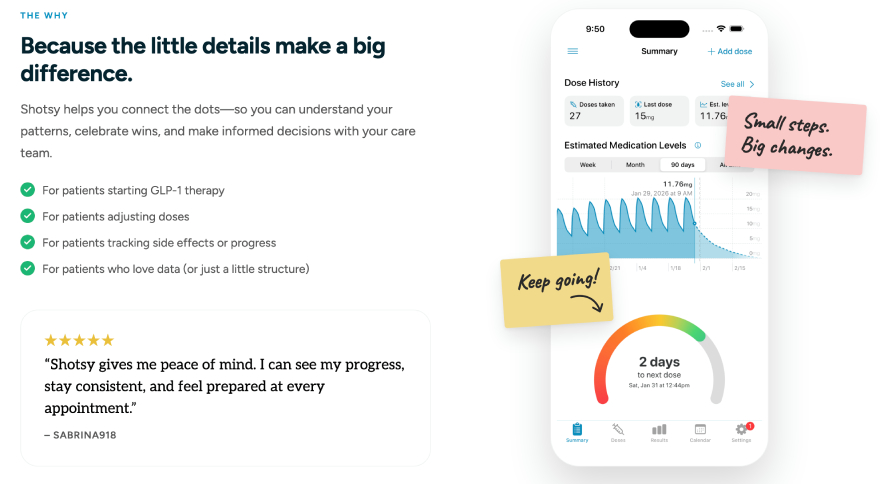
The estimated medication-level charts are probably the app’s most recognizable feature. Instead of just showing the dates of previous injections, Shotsy provides an estimate of how medication levels fluctuate between doses.
The charts can also add side effects to those estimates, giving users a chance to see if certain symptoms tend to pop up around similar points in their schedule. Of course, these are only estimates, and shouldn’t be taken as medical advice, but it’s still a more interesting approach than a plain list of injections.
The Shotsy GLP-1 tracker is also decent for tracking progress beyond a number on the scale. Users can log weight, calories, protein, water, side effects, and then see what patterns emerge over time.
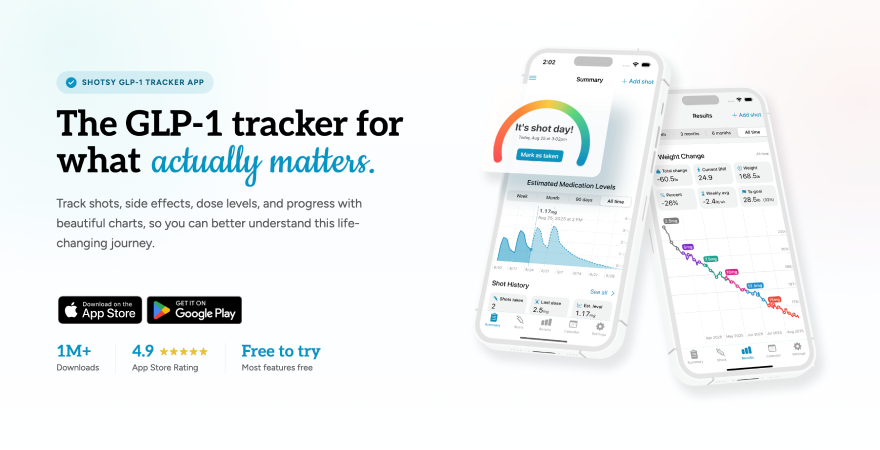
The injection site tracking is also worth mentioning. Current versions of the app enable users to record and rotate injection sites on a visual map. Newer analytics can also separate results by injection site and dosage, which makes it easier to see how each piece of your routine fits into the bigger picture.
Finally, Shotsy says its core dose, side effect, weight, and nutrition features are free to use, so users can get a feel for the workflow before deciding whether the premium Shotsy app cost is worthwhile.
Shotsy does a good job of what it’s meant to do, but that job is a bit narrower than the name “peptide tracker” might suggest. While the app has plenty of positive aspects to talk about, some user Shotsy reviews point out the following limitations:
Shotsy isn’t really designed to address the broader peptide landscape. The platform says it is specifically a companion for people on GLP-1 treatments, with its core experience revolving around drugs from that category.
The app can handle more than one supported medication and changes in schedule, but it's not designed as an open-ended protocol builder for users blending multiple different peptides. Custom compounds, advanced stack management, and broad unit support aren’t something you can expect.
Shotsy also doesn’t have a dedicated reconstitution calculator, nor does it feature full vial tracking, expiration monitoring, or stock alerts.
Lastly, Shotsy’s medication level visualization is interesting, but needs to be read correctly.
The app uses dose information entered by the user and generalized clinical data[2] to calculate estimated levels. Shotsy itself says that these numbers are nothing more than estimates, and that the app is not a diagnostic tool.
So, is Shotsy good given these limitations? Well, yes - it’s a capable Shotsy GLP-1 tracker, but at the same time, it’s not a great choice if you want detailed peptide preparation, inventory control, or multi-compound protocol management.
Moving on, let’s split this Shotsy app review into a few dedicated sections talking about the main, key features of the platform.
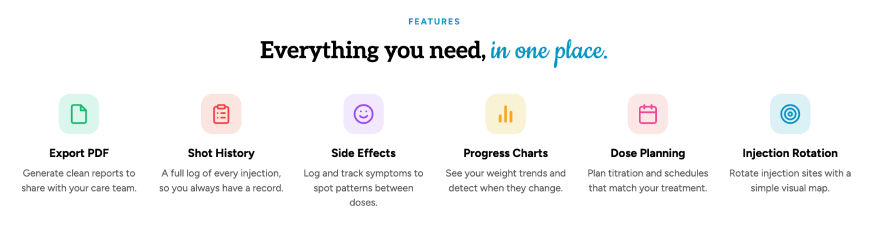
Shotsy is built around dose logging. Users can log the drug, dose, date, and time of injection to create a history that can be reviewed later. The app also supports daily oral GLP-1 medications, so it isn’t totally limited to injections.
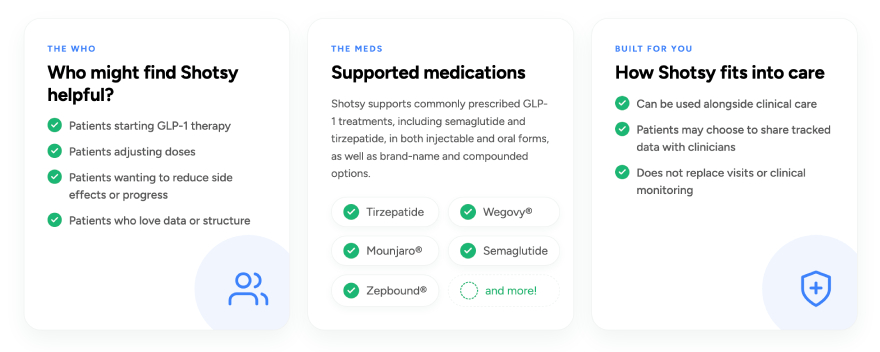
The drug options include some of the heavy hitters, such as semaglutide, tirzepatide, liraglutide, and dulaglutide. Brand-name and compounded medications can also be monitored.
You can keep track of multiple peptides at once, and each one can have its own schedule. That can be useful when moving between treatments or when following a more complicated plan from a healthcare provider.
Shotsy lets you pick the day and time for an injection, and receive reminders + a countdown to the next scheduled dose. Daily oral medications can follow their own schedules rather than being forced into a weekly or monthly format.
Additionally, there are also dose planning and titration tools available. The reminders themselves are simple, but they directly feed into the user’s dose history, medication schedule, and progress data.
One of Shotsy’s most distinctive features is its medication-level visualization.
The app also tracks doses and produces a chart estimating how medication levels might rise and fall between administrations. These calculations are based on scientific data on GLP-1 meds.

Instead of just seeing that a dose was taken on Monday, users get an estimated curve over the next few days. Shotsy can also show combined estimates when a few supported medications are being tracked.
Common side effects may be recorded as they happen to create a record that can be referred to at a later date. Symptoms may also be compared to injection timing, nutrition, hydration, and estimated medication levels.
Such a comparison might show patterns that recur, for example, a symptom appearing at the same point after each dose.
Shotsy's side effect records don't prove the underlying medication curve caused the symptom, but they can make conversations with a healthcare provider more specific.
Shotsy lets you log your weight and view it as it changes on charts for every week, month, and your entire weight loss journey. The app doesn’t treat each measurement as a separate number, instead turning the entries into a longer-term trend.
There’s also maintenance mode on Shotsy. Once a goal is reached, the experience may change from continued weight loss to long-term maintenance. That’s a good addition, since many tracking apps are still purely focused on weight loss even after the user’s goal has changed.
Shotsy has a visual injection map that records where previous doses were administered. The app can tell you the next spot in a rotation, so you don't keep injecting in the same spot. Progress data may also be analyzed by injection site.
Notably, it’s not as detailed as some of the injection site management tools on other peptide apps, but it still fits within a GLP-1 weekly routine.
In addition to the medication data, Shotsy also allows users to log their calorie consumption, protein & water intake, and weight. These tools aren’t meant to replace a dedicated nutrition platform, but they do provide context around treatment and progress.
The app supports both Apple and Google Health integrations. There is also manual data entry available for when users don't want to connect their other platforms.
Shotsy can also produce PDF reports with dose history, injection sites, weight trends, side effects, and other charts. This provides users with a cleaner way to share their records with a healthcare provider.
All of these tools combined do a pretty good enough job of answering the question “is Shotsy good?” within the GLP-1 app category.
Let’s discuss the Shotsy app cost.
Shotsy utilizes a freemium model, which means that you can download the app and use its core tracking tools without having to commit to a subscription right away. The free version has all of the core functionality enabled, including dose logging, side effect records, weight charts, and nutrition tracking.
Here’s what the pricing of the app looks like:
| Period | Price |
|---|---|
| Weekly | - |
| Monthly | $9.99 |
| Annual | $39.99 |
The premium plan will probably appeal most to users who want the more advanced analytics, additional customization, exports, widgets, and other convenience features added around the core tracker.
Is the Shotsy app cost reasonable? I’d say so. It’s a good price for a polished GLP-1 app, especially compared to the likes of MeAgain’s annual pricing.
If you just want a weekly reminder and a simple dose history, the value is less obvious. If so, the free version may already have much of what you need.
Now, by this point in the Shotsy app review, you should have a pretty good idea of whether or not you’d like to try the platform out for yourself. If that’s the case, I’ve got you covered - I’ve come up with a quick rundown of how you can get started with the app.
Check it out:
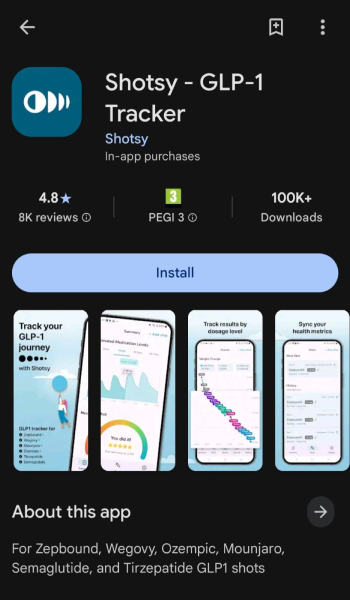
Download the Shotsy app.
First, download Shotsy from the Apple App Store or Google Play Store. The app is free to download, and you don’t have to buy a subscription right away. Once installed, open the app and sign in.
Pass the quiz.
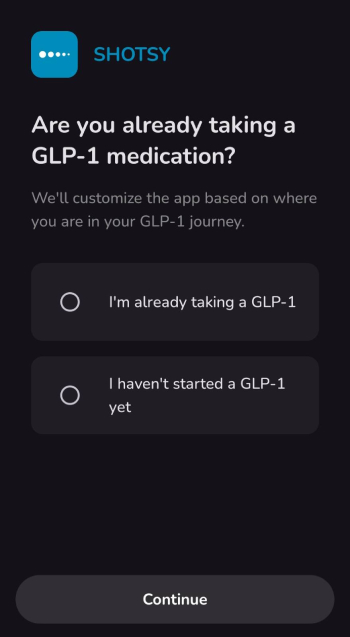
Shotsy will ask you to select the GLP-1 medication you are on, or that you plan to use. Then, you’ll need to select your dose and set up the schedule you want to follow. You can choose from daily, weekly, and other time interval-based injections.
Time to explore the app!
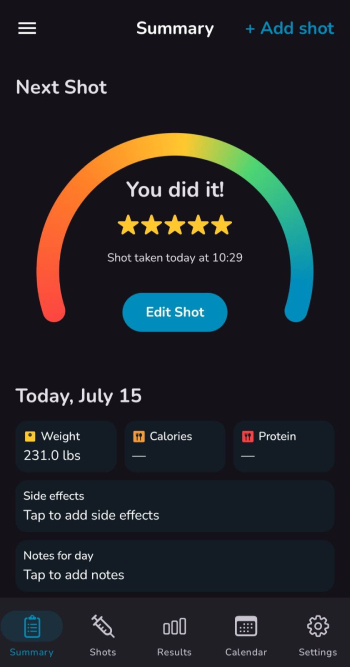
Once you’ve passed the quiz, you are now ready to explore all that Shotsy has to offer! Well, kind of - the free version is quite limited, but still - the core functionality is there.
You can log shots, view your history, see your results, and interact with the calendar (which can be a convenient way to manage your doses). Same as with most other apps of this kind, all of the most important sections can be accessed via the menu panel at the bottom of the screen.
Since Shotsy covers a specific peptide niche, it shouldn’t be difficult to find your footing and start exploring the app. Most of its functionality is pretty straightforward.
To finish off this Shotsy review, let’s take a look at the other peptide trackers, and how they compare to our GLP-1 tool in question.
| Shotsy | MAX Peptide AI | |
|---|---|---|
| Peptide Support | Multiple GLP-1s | 100+ |
| Injection / Dosing Reminders | ✅ | ✅ |
| Side Effect Tracking | ✅ | ✅ |
| AI Features | ❌ | ✅ |
| Integrations | Apple Health, Google Health, wearables (limited) | Apple Health, Google Health, wearables |
| Pricing | Monthly - $9.99 Annual - $39.99 | Weekly - $7.99 Monthly - $12.99 Annual - $49.99 |
| Best for | GLP-1 users looking for a data-driven app. | People who want to track their peptide use and improve nutrition, sleep, training, and recovery. |
MAX Peptide AI and Shotsy have a lot of overlap in the main areas. Both can record GLP-1 doses, injection schedules, side effects, injection sites, weight changes, and different aspects of nutrition.
But where the difference comes in is what happens beyond those fundamentals.
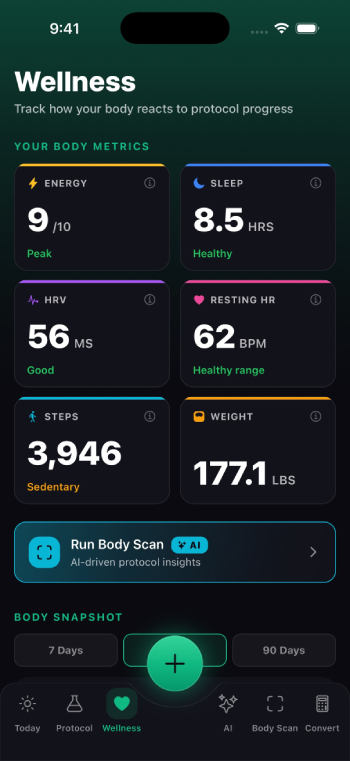
Shotsy is developed specifically around GLP-1-based treatment. It features a nice little toolkit for someone who is on drugs such as Wegovy, Ozempic, Mounjaro, or Zepbound.
MAX Peptide AI casts a much broader net. It supports 100+ protocols and features dose tracking, custom stacks, a dosage calculator, a reconstitution calculator, AI body scans, lab analysis, sleep data, recovery, workouts, nutrition, hydration, and body composition trends.
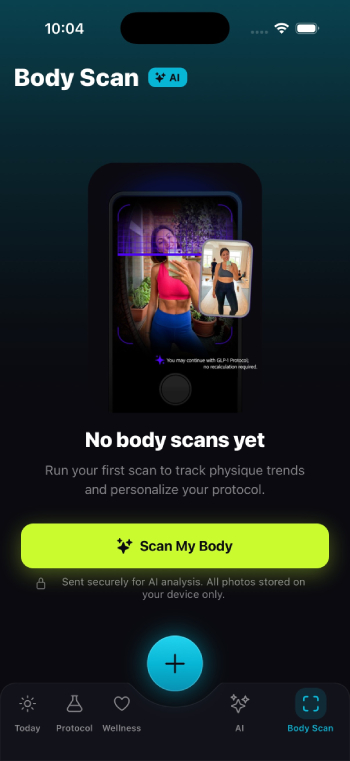
That broader framework gives MAX Peptide AI an advantage for users whose needs might evolve beyond GLP-1s. With Shotsy, most of that additional stuff would have to be handled elsewhere. MAX Peptide AI is intended to keep everything in the same environment.
Shotsy is still worth recommending to anyone looking for a slick GLP-1 diary and little else. But if I were to choose the better all-around platform, it would be MAX Peptide AI - no doubt about that. It has the basic features that people want in a Shotsy GLP-1 tracker, but also allows for much more advanced tracking.
✨ Explore More: MAX Peptide AI Review
Shotsy and MeAgain are much more similar than Shotsy and MAX Peptide AI, in that both of the former platforms are aimed at a similar audience.
Both are about the everyday GLP-1 experience, not advanced peptide protocols. Both apps let you log medication, symptoms, food, hydration, weight, and injection sites.
MeAgain is more focused on lifestyle engagement. You can log meals by pictures, voice input, barcode scan, and manual search. It also monitors protein, fiber, water, progress photos, and weight, with a virtual companion called Capy to keep you company and answer questions.
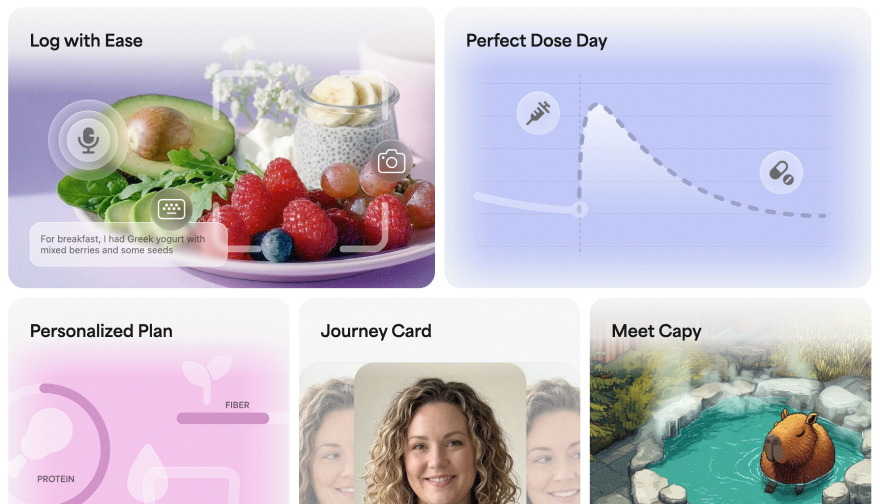
Shotsy, in contrast, is more analytical. Its identity is derived from medication schedules, estimated level curves, dose-associated weight charts, maintenance tracking, and short reports that can be shared with your physician.
If food logging, visual progress, and daily encouragement are key parts of your routine, MeAgain may be a better fit for you. If you’re more concerned about your injection timeline, medication estimates, and a cleaner, clinical-style history, Shotsy is probably the better fit.
It’s not the best choice for reconstitution, vial management, or large peptide stacks. For those needs, I would again turn to MAX Peptide AI, and not either of the GLP-1-specific platforms.
✨ Explore More: MeAgain Review
Shotsy begins with GLP-1 treatment and then builds general progress tools on top of it. Pep AI, by contrast, begins with peptide management. Features include vial tracking, dose logging, reminders, side effect records, meal scanning, nutrition, sleep tracking, and Apple Health sync.
This makes Pep AI a better Shotsy alternative for users who handle vials or want their peptide inventory connected to their tracking routine.
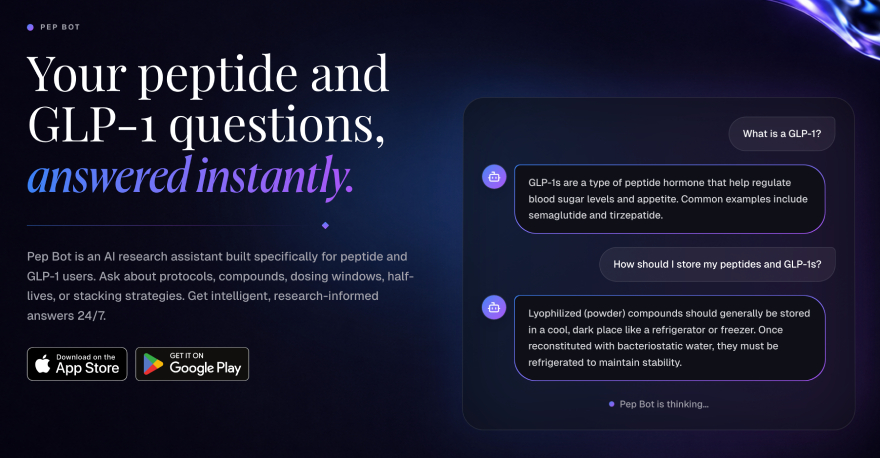
Shotsy does not offer a true reconstitution calculator or a full vial management system. It’s easier to navigate, more firmly focused on familiar GLP-1 drugs, and especially good at displaying weight, symptoms, dosages, and estimated drug levels together.
Pep AI provides a more peptide-oriented structure. Shotsy is a more elegant GLP-1 experience. Of the two, I’d pick Shotsy for a simple semaglutide or tirzepatide regimen, and Pep AI for broader peptide organization.
✨ Explore More: Pep AI Review
And that wraps up our Shotsy app review.
To summarize, Shotsy is a sleek and functional GLP-1 tracker. It does dose logging, reminders, estimated medication-level charts, injection site rotation, symptoms, weight, nutrition, and progress reporting without making the experience unnecessarily complicated.
So, is Shotsy good? It’s definitely decent for someone on a GLP-1 drug. The free version is handy, the yearly subscription is fair, and the app’s focused approach makes it easy to slot into a weekly routine.
The biggest limitation is that Shotsy is exclusively for GLP-1 management, not full peptide protocol tracking. There are no good tools for vial inventory, reconstitution calculations, or support for more compounds.
My favourite Shotsy alternative for people wanting a more complete health and peptide ecosystem is MAX Peptide AI. Be sure to check this app out for yourself!



 Verified
Shotsy does have a free version with core tools like dose logging, weight tracking, side effect records, and basic nutrition monitoring. Other analytics and convenience features might be available for a premium subscription.
The standard Shotsy app cost is $9.99 per month, or $39.99 per year. Prices may vary based on platform, location, or any promotional offer available. It’s considered to be an affordable peptide tracker app when compared to the likes of MeAgain, but if you keep in mind the fact that MAX Peptide AI is priced similarly, yet offers full peptide management tools, the story becomes a bit more complicated.
Yes, the Shotsy GLP-1 tracker works with tirzepatide-based medications like Mounjaro and Zepbound. Users can log doses, schedule reminders, record weight, track symptoms, and see estimated medication level charts.
Yes, Shotsy works with popular semaglutide drugs including Ozempic and Wegovy. On top of that, it also supports a number of other GLP-1 therapies, including injectables and oral treatments.
No, Shotsy does not have a specific peptide reconstitution calculator, at least as of writing this review. If you’re someone who’s working with compounded vials or multiple peptides, you might want to consider a broader Shotsy alternative like MAX Peptide AI.
No. Shotsy can help organize medication schedules, symptoms, and progress data, but the app can’t provide a diagnosis or replace instructions from a healthcare professional. Its medication level charts are estimates, and should not be used to change a dose on your own.
Join 60,000+ longevity biohackers and get our 5-min weekly read with the latest findings, research-backed protocols and tips to boost your daily habbits!
Searching for results...
Please wait while we find the resultsNo results found for ""
Try searching for a different termSomething went wrong
Please try again later